Ultraviolet radiation

    Overview

    Ultraviolet (UV) radiation covers the wavelength range of 100–400 nm, which is a higher frequency and lower wavelength than visible light. UV radiation comes naturally from the sun, but it can also be created by artificial sources used in industry, commerce and recreation.

    The UV region covers the wavelength range 100-400 nm and is divided into three bands:

    • UVA (315-400 nm)
    • UVB (280-315 nm)
    • UVC (100-280 nm).

    As sunlight passes through the atmosphere, all UVC and approximately 90% of UVB radiation is absorbed by ozone, water vapour, oxygen and carbon dioxide. UVA radiation is less affected by the atmosphere. Therefore, the UV radiation reaching the Earth’s surface is largely composed of UVA with a small UVB component.

    The amount of UV radiation from the sun that hits the Earth’s surface depends on several factors, including the sun’s height in the sky, latitude, cloud cover, altitude, the thickness of the ozone layer and ground reflection. Reductions in the ozone layer due to human-created pollution increase the amount of UVA and UVB that reaches the surface. This can impact human health, animals, marine organisms and plant life. In humans, increased UV exposure can cause skin cancers, cataracts and immune system damage.

    Prevention

    The rise in the number of cases of skin cancer over the past decades is strongly related to increased exposure to the sun during outdoor activities and to artificial sources of UV radiation such as sunlamps and tanning beds. Overexposure is also the underlying cause of harmful effects on the eyes and immune system.

    Adopting a few simple precautions can greatly reduce the risk of these health conditions:

    • Limit time in the midday sun from 10 a.m. to 4 p.m., particularly on days when the UV index is high.
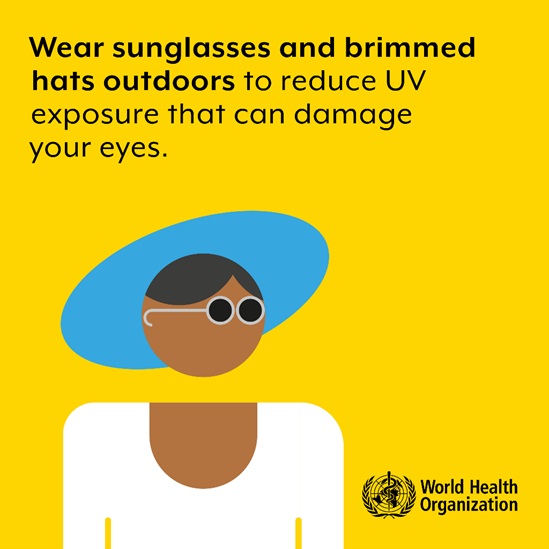
    • When UV rays are most intense and you must be outside, try to find shade and wear protective clothing, including a brimmed hat that provides sun protection for your head, face and neck.
    • Use a broad-spectrum sunscreen of at least 15 SPF – ideally higher– and reapply every 2 hours.
    • Avoid sunlamps and tanning parlours, as they are known to damage the skin and eyes.

    Children’s UV exposure should be carefully limited because they are in a dynamic state of growth and therefore more susceptible to environmental threats than adults. Many vital functions such as the immune system are not fully developed at birth, and unsafe environments may interfere with their normal development.

    WHO Response

    WHO works with Member States and partners to increase public understanding of the effects of overexposure to ultraviolet radiation.

    The INTERSUN Programme is a collaboration between WHO, the United Nations Environment Programme, the World Meteorological Organization, the International Agency on Cancer Research and the International Commission on Non-Ionizing Radiation Protection. It promotes and evaluates research on the health effects of UV radiation, and develops an appropriate response through guidelines, recommendations and information dissemination. The goals of the programme including providing practical and sound advice on the health and environmental impacts of UV exposure, to encourage countries to take action to reduce UV-induced health risks and to provide guidance to national authorities about sun awareness programmes.

    To this end, the programme collaborates with experts and specialist agencies to implement key research activities, identifies and quantifies health risks from UV radiation, develops reliable predictions of health and environmental consequences of changes in UV exposure with stratospheric ozone depletion, and develops practical ways of monitoring change in UV-induced health effects over time.

    The programme provides tools and guidelines related to the UV index, sun protection for children, artificial sunbeds, tourism and occupational health.
    News

    All →

    Latest publications

    All →
    Heat, air pollution and solar ultraviolet radiation: mass gathering-specific considerations and research gaps

    The annually averaged global mean near-surface temperature in 2024 was 1.55 °C ± 0.13 °C above the 1850–1900 average. This made it...

    International travel and health - module 2: environmental health risks

    Depending on the health profile of the traveller, the type of travel to be undertaken, and the place of transit and destination, travellers may face various...

    Compendium of WHO and other UN guidance in health and environment, 2024 update

    This is the 2024 update of the Compendium of WHO and other UN guidance on health and environment. The Compendium is a comprehensive collection of available...

    Compendium of WHO and other UN guidance on health and environment: version with International Classification of Health Intervention (‎ICHI)‎ codes

    In this version of the compendium, each guidance is coded using the International Classification of Health Interventions (ICHI).The compendium provides...

    Our work

    Videos

    All →

    Podcasts

    Episode #119 - UV radiation

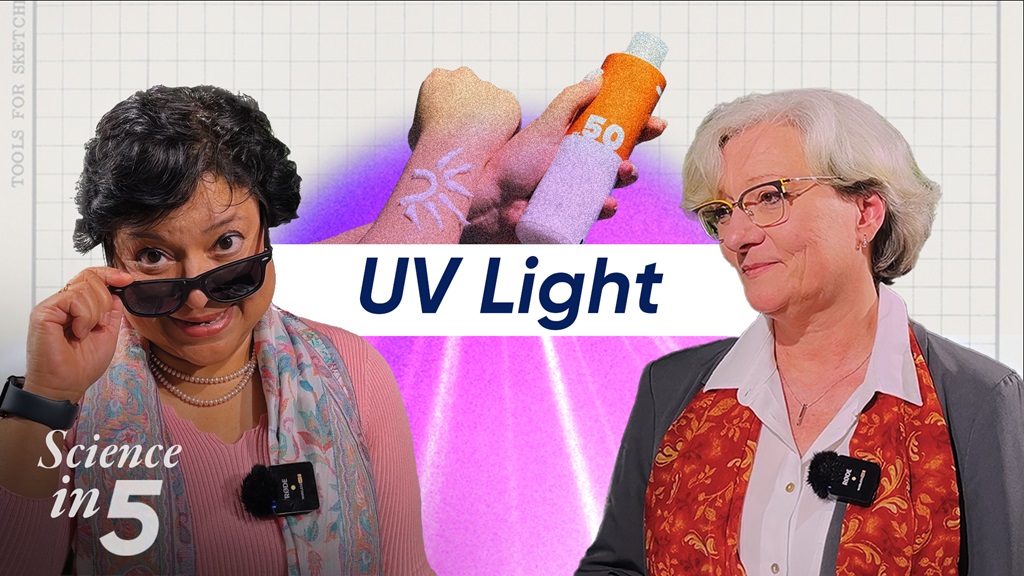
    Did you know that putting on your sunglasses is one of the ways to protect your eyes from cataract ? Learn about ways to protect yourself from UV radiation from Dr Cornelia Baldermann, Scientific Senior Consultant, at the German Federal Office for Radiation Protection. Dr Baldermann explains where UV radiation comes from and how it impact our health in Science in 5.
    Presented by
    Vismita Gupta-Smith

    Alternative media

    Transcript

    VGS Did you know that putting on your sunglasses is one of the ways to protect your eyes from cataract? We are talking about ultraviolet rays today, UV rays. Where do they come from? What impact do they have on your health? How can you protect yourself? And our expert today is Dr. Cornelia Baldermann. Welcome Cornelia.

    CB Hi.

    VGS Where do UV rays come from?

    CB UV or ultraviolet radiation comes from the sun but it can also be artificially generated, for example in sun beds. UV radiation is not perceivable, you can’t see that, you can’t sense it, so, this is very unfortunate because UV radiation is giving us more health effects, negative health effects, for example, in short-term, sunburn, you know, eye inflammation and for the long-term, premature skin ageing and skin cancer. Also cancer of the eyes. UV radiation is classified as carcinogenic to humans. Why? Because UV radiation is damaging DNA and too much UV is damaging [the cells] too much, so they can’t repair this damage again. And therefore these affected cells can degenerate into cancer cells. The only positive effect of UV radiation is the synthesis of vitamin D in our body. But this is happening simultaneously to the negative effects and before you are sunburned. So, be careful about your sun exposure.

    VGS So we're going to come back to vitamin D in a minute. Let's first talk about how we can protect ourselves from ultraviolet radiation.

    CB UV protection is very necessary, you heard, because of the skin cancer, for example, and especially for the children. But it’s very very easy, so, do it like this: First, avoid UV exposure. Too much UV exposure means, seeking shade, using an umbrella or don’t even go outside in the midday time. Secondly, what you can do is to cover [yourself] up. So use a broad-brimmed hat, use sunglasses for your eyes, as you shared before, use clothes and also shoes so that the body is protected. If there is already unprotected skin, then you can use sunscreen for that.

    VGS So what about vitamin D? Aren't we concerned about vitamin D when we take all of these protective measures because we are supposed to go out and exercise and walk in the woods and out in the sun, right?

    CB Yeah, this is a good question because vitamin D is very important for our health. But sun protection measures don’t mean to block the vitamin D synthesis. It’s still running, just in a delayed way. So the main point is, don’t go out in the sun just for getting Vitamin D, this is not necessary. There is a pill to treat vitamin D deficiency, but no pill to treat skin cancer.

    VGS I have another question for you. I have darker skin, so I have more melatonin, does that mean that I’m more protected from ultraviolet radiation?

    CB Dark skinned people, like you, are not so sensitive to UV radiation as fair skinned people. The lighter your skin, the earlier you get the UV exposure negative effects. So, it’s very important that you know your skin, how sun sensitive is your skin and when it will come to sunburn. When you know this, with this knowledge, you can already manage your sun exposure and your time outdoors.

    VGS How would we know about UV radiation if we can’t see it or sense it?

    CB Yeah, this is really a problem, but we have a solution. There is the UV index. This is a scale, with whole numbers, starting with one to eleven and above, and the higher this number the [more] intense the UV radiation is. So it means when you start to get outside, so use, for example, weather apps or something like that, showing you the UV index or use the SunSmart app, showing you your own sun protection times.

    VGS Cornelia, explain to us if we are not in direct sunlight, if we are in shade, are we still exposed to UV radiation?

    CB Yes, shade reduces the UV radiation, but it’s not blocking the UV radiation totally. So it means UV radiation is scattered and therefore, everywhere you are. In shade you can get burnt, you can get a tan and also, you can get vitamin D. Thus, shade alone does not mean 100 per cent UV protection. So, go out and be aware of your sun exposure and sun protect yourself. Let me say, this all sounds [like you’re] not allowed to go out in the sun. This is not the case, of course not. To be in the sun and to be outside, it’s very healthy. So, go out, enjoy the sun and do your sun protection very clever and in the end, avoid sunburn.

    VGS Thank you Cornelia, there you have it, that was Science in 5 today. Until next time then, stay safe, stay healthy and stick with science.

    Speaker key

    • CB Cornelia Baldermann
    • VGS Vismita Gupta-Smith