
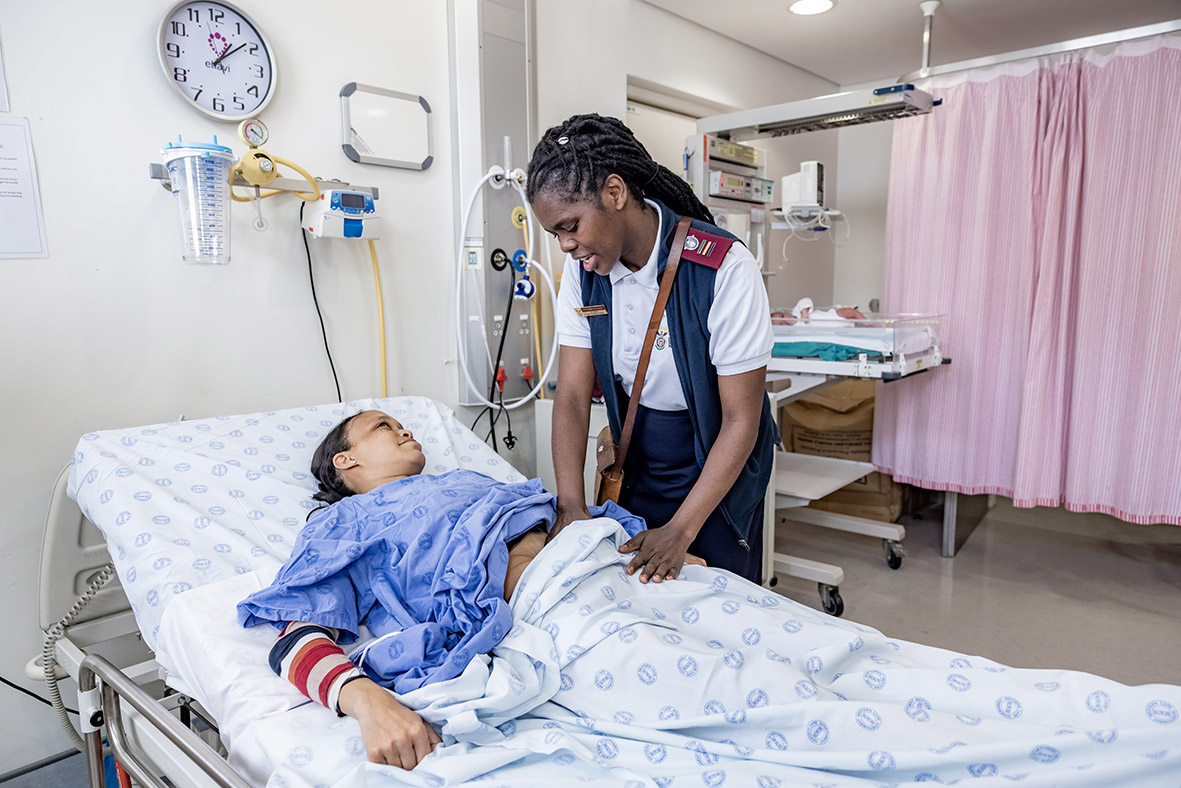
Noxolo Hoga, Advanced Midwife, uses the calibrated drape, a cone-shaped plastic sheet with a measurement pouch, which is used to accurately collect and quantify blood loss after delivery, Mitchells Plain District Hospital, Cape Town, South Africa.
REACH trial: Research to Expand Access to Heat-stable Carbetocin for the Treatment of Postpartum haemorrhage
An international phase III randomized trial is underway examining if Heat-stable carbetocin (HSC) is as safe and effective as oxytocin in treating Postpartum haemorrhage (PPH) in women who have already received HSC for prophylaxis of PPH. The trial aims to enroll 6,200 women across seven countries (Argentina, India, Kenya, Nigeria, South Africa, Uganda and the United Kingdom).
PPH is a leading cause of maternal deaths worldwide. Most deaths occur in low- and middle-income countries (LMICs) and could be prevented with timely access to effective, quality assured medicines. WHO guidelines recommend oxytocin as the gold standard for PPH treatment. However, it requires refrigeration, which is difficult to consistently ensure in many LMIC settings where electricity supplies are often unstable. HSC does not need cold storage, making it better suited for resource-limited areas.
This project will generate primary evidence on the safety and efficacy of HSC for PPH treatment in women who received HSC for PPH prophylaxis, to support its scale-up globally and nationally. If the trial confirms HSC is safe and non-inferior to oxytocin, PPH treatment guidelines are expected to be revised, the WHO Essential Medicines List updated, and regulatory approval extended to include HSC for PPH. These actions will impact country-level policy and programmatic action.
/sexual-and-reproductive-health-and-research-(srh)/maternal-and-perinatal-health-(mph)/a-focus-on-expanding-access-to-medication-for-postpartum-haemorrhage.tmb-549v.png?sfvrsn=bccd86bb_1)
/sexual-and-reproductive-health-and-research-(srh)/maternal-and-perinatal-health-(mph)/graphic-elements.png?sfvrsn=384d4b06_3 "Graphic elements")